 Categories
When you pick the wrong barrier for a job, you find out fast. Either you’ve paid for permanence a six week project never needed, or you’ve underbuilt something that was supposed to last for the next thirty years.
Harper Precast has been manufacturing highway barriers in Utah and throughout the Intermountain West region since 2006, and the mistakes we see rarely come down to a bad barrier. Instead, they come down to a barrier picked for the wrong reason: whatever was on the lot, whatever the last project used, whatever seemed easiest to order.
That’s what this guide is here to fix. We’ll walk through the differences between temporary and permanent barriers, what matters when it comes to anchoring, and why transitions are so often where a solid plan comes apart at the seams.
Temporary barriers exist to solve a problem that has an end date. Think lane closures, active work zones, or a detour that needs traffic rerouted for a few weeks while crews finish the job underneath. These barriers get placed, do their work, and get picked up again for the next job down the road. Flexibility and fast deployment matter more here than anything else.
Permanent barriers are a different animal entirely. They’re the bones of a project: median dividers, property boundaries, long-term highway separation. They need to endure decades of weather, traffic loads, and whatever else nature throws at them.
The most common form you’ll see either way is the F-shape jersey barrier, a compact concrete structure engineered to separate traffic and redirect vehicles away from further collision if they’re struck. Its sloped face is designed to guide a vehicle’s tire back onto the road, which matters just as much on a two week detour as it does on a permanent interstate median.
Too many projects look at the temporary vs permanent barriers from a budget angle when it should be about duration and risk exposure. A barrier rented for a short closure doesn’t need the same foundation work as one that’s staying put through every freeze and thaw cycle for the next generation. It’s important to match the barrier type to its desired duration.
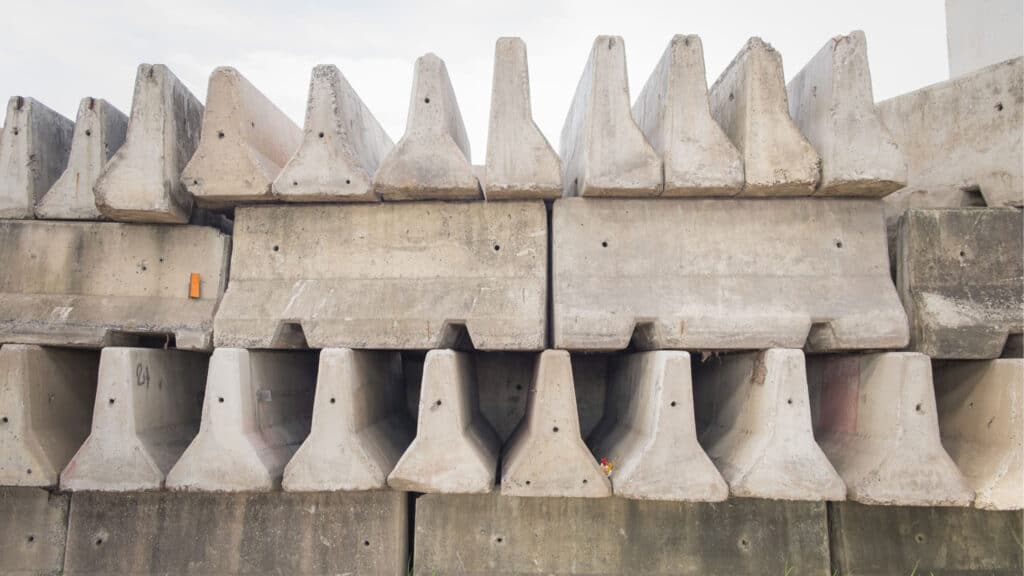
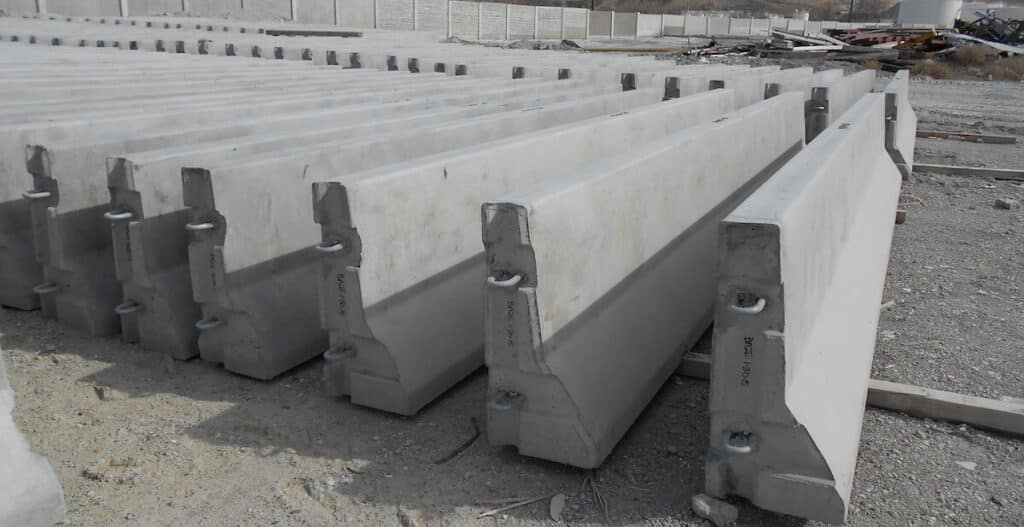
Freestanding barriers rely on their own mass and interlocking connections to stay put. Our precast jersey barriers use a strong interlocking system that appends segment to segment, forming a continuous line without requiring ground penetration at every joint. That works well for temporary applications and sites where you can’t drill into the surface, such as paved lots you don’t own or roadways with utilities running underneath.
For permanent installs, especially anything near high speed traffic or on a grade, engineers will often specify anchoring into the substrate. This helps control how barriers behave on impact, which is a safety calculation as much as a structural one.
Soil conditions, slope, and substrate types all factor into which anchoring approach makes the most sense. A barrier anchored into stable bedrock doesn’t behave like one sitting on loose fill. Working with a manufacturer who understands both the product and the installation, rather than just shipping segments and walking away, saves headaches down the line.
You can spec the perfect barrier type and nail the anchoring, and still end up with a hazard if the transitions aren’t handled effectively.
Transitions happen anywhere a barrier changes: barrier to guardrail, barrier to bridge rail, one height to another, or simply one section ending and the next beginning at a different elevation. Skip the engineering here and you’ve created a gap, a snag point, or a stiffness mismatch that can turn a minor impact into a serious one. Vehicles don’t care that the transition zone was an afterthought. Physics doesn’t negotiate.
Well designed transitions taper gradually, matching stiffness and height across the change so a vehicle traveling along one barrier type doesn’t hit an abrupt wall of resistance, or worse, a gap, when it reaches the next. This is precisely where custom fabrication earns its keep.
Harper Precast collaborates directly with engineers and developers to design components that meet exact project specifications.
So how do you actually land on the right combination? A few questions tend to cut through the noise fast:
Answer those honestly and the temporary vs permanent question usually answers itself.
It also helps to work with a manufacturer whose products have already been through the wringer. Harper Precast is an NPCA-certified plant and a 13-time UDOT Gold Class Producer, which means we hold our barriers to high standards that go well beyond “looks solid enough.” That track record covers highway expansions, commercial sites, and everything in between across Utah, Washington, Oregon, California, and the rest of the Intermountain West region.
Have a project that needs the right barrier, engineered the right way? Reach out to the Harper Precast team, and let’s figure out what your site needs.


