 Categories

The construction industry is standing at a crossroads. With buildings and infrastructure responsible for nearly 38% of global CO₂ emissions (World Green Building Council), embracing more sustainable construction methods isn’t just a trend—it’s a necessity.
While concrete often carries the stigma of high environmental impact, precast concrete is flipping the script. Through streamlined manufacturing, reduced waste, and long-lasting durability, precast is proving itself as one of the most sustainable materials for building construction available today.
So, what is sustainable construction in practice? It’s not just about solar panels and reclaimed wood—it’s about using materials that reduce resource consumption, enhance performance, and stand the test of time. That’s where precast shines.
Between global climate commitments, evolving building codes, and client-driven green standards, sustainability in construction has become non-negotiable. Builders, developers, and public agencies are under increasing pressure to reduce environmental impact while maintaining efficiency and safety.
Construction output is projected to double by 2060. Without a shift in materials and methods, that growth could accelerate environmental degradation.
Regulatory frameworks like LEED, municipal building ordinances, and ESG benchmarks are pushing the industry to rethink everything—from site selection to material sourcing. But true sustainability isn’t just about meeting regulations; it’s about future-proofing projects and communities.
To earn the title “sustainable,” a building material has to do more than one thing well. It needs to lower emissions, keep waste to a minimum, last for decades, and perform across its entire lifecycle.
Precast concrete checks every box. It’s efficient, durable, and adaptable—the kind of solution today’s builders need if they’re thinking beyond just the next project.
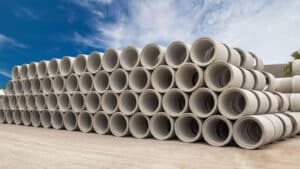
Let’s debunk the myth: not all concrete is created equal. Precast concrete in construction significantly outperforms traditional cast-in-place concrete in terms of environmental impact. Here’s how:
Every piece is produced in a factory setting, minimizing waste and maximizing precision. That means fewer reworks, tighter tolerances, and consistent quality.
Precast production uses energy-efficient curing methods and optimized mix designs. This leads to lower embodied carbon compared to traditional site-poured alternatives.
With off-site production, there’s less machinery on site and fewer delays. That means lower diesel usage, noise, and overall jobsite disruption.
Precast concrete doesn’t just hold up—it holds strong. Its natural resistance to weather, wear, and time means fewer repairs, longer service life, and less waste over the lifespan of a structure.
In a world where building smarter matters more than building bigger, precast strikes the balance between performance and responsibility, making it a true standout in the sustainability conversation.
How does precast stack up against traditional construction methods?
| Feature | Precast Concrete | Cast-in-Place / Steel |
|---|---|---|
| Waste | Minimal, factory-controlled | High—on-site excess, rework common |
| Emissions | Reduced via off-site production | Higher due to prolonged site activity |
| Installation Speed | Fast, modular installation | Slow—formwork, curing, weather delays |
| Labor Needs | Lower—streamlined teams | Higher—multiple trades, longer hours |
| Durability & Reusability | High—long life, often recyclable | Variable—susceptible to corrosion/cracking |
Sustainable construction practices demand smarter choices from the ground up. Precast offers a more efficient, cleaner, and longer-lasting solution than traditional poured concrete or steel.
Sustainable modular construction is fast becoming the gold standard, and precast is perfectly suited for it.
With off-site production, projects move faster and more predictably. Shorter build times mean less equipment idling, reduced fuel consumption, and fewer emissions from labor and transport.
It’s also highly adaptable. Whether you’re building affordable housing, hospitals, or commercial spaces, precast modules deliver consistency, scalability, and flexibility—all while supporting sustainability in construction materials.
Precast concrete’s modularity also supports disaster recovery and emergency builds. Structures go up faster, perform better, and require minimal site intervention—ideal for communities needing resilient, low-impact construction methods.
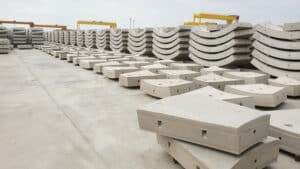
At Harper Precast, we’re not just manufacturing concrete—we’re building smarter, cleaner systems from the ground up.
Here’s what sets us apart:
With over 50 years of experience across Utah and the Intermountain West, we’re proud to offer sustainable materials for construction that don’t compromise on strength, speed, or design.
Innovation is transforming concrete, and precast is leading the way.
The construction world is evolving fast, and precast is built to keep up.
When Thermo King sought a fencing solution that balanced durability, visual appeal, and sustainability, they came to Harper Precast.
We designed and installed 376 feet of 8-foot Canyon Stone decorative fencing, along with two custom dumpster enclosures.
The result? A low-maintenance, high-impact solution that enhanced curb appeal while standing up to the elements. More than a fence—it was a long-term investment in durability, design, and sustainable house construction practices.
Explore more Harper Precast projects
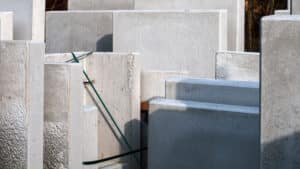 The Future of Sustainable Construction
Let’s recap what makes precast concrete the future of sustainable construction:
From high-performance infrastructure to custom residential builds, precast delivers on sustainability, strength, and scalability.
Reach out to Harper Precast to explore eco-conscious precast solutions designed to meet your project’s performance and sustainability goals.
📩 Contact Harper Precast today and start building smarter.


